








Single Drawn vs Double Drawn Hair: Types 1 to 4 Explained
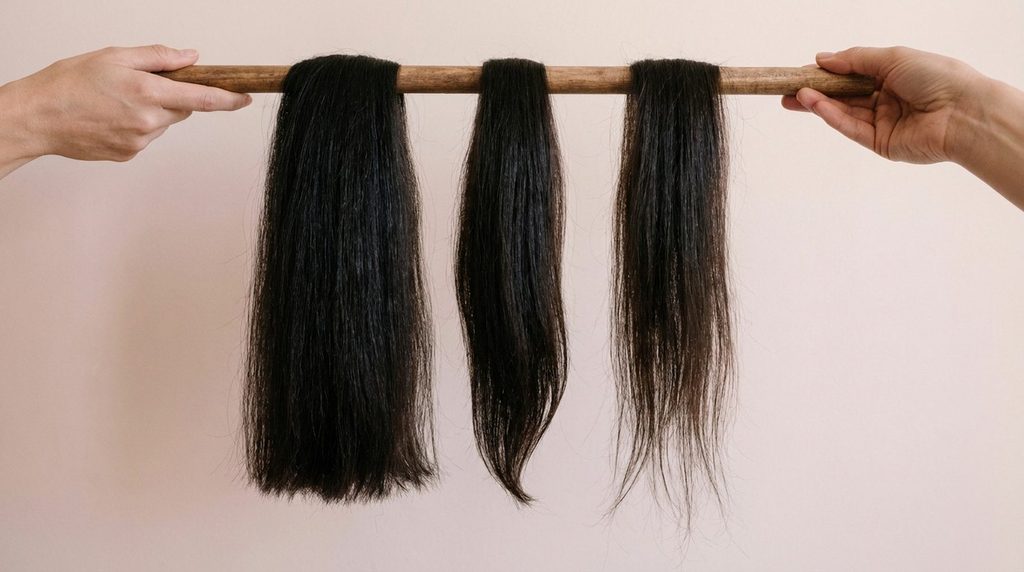
Single drawn hair keeps a natural mix of long and short strands, so it tapers to thinner ends. Double drawn hair has most short strands removed, so the bundle stays thick from top to bottom. Super double drawn is the fullest grade, with about 60% of strands at full length. Double drawn looks fuller and costs more; single drawn looks more natural on fine hair and costs less.
What "drawn" means
A ponytail cut from one person contains hair of many lengths. If you hold a 60 cm bundle, only part of it actually reaches 60 cm. "Drawing" is the handwork of pulling hair through hackles to separate the short strands and recombining bundles so that more strands reach the full length. One pass gives single drawn hair; repeated passes give double drawn hair. Our workers only recombine hair with the same texture, shade and thickness, so a drawn bundle behaves like hair from one person.
Our four quality types
| Type | Name | Strands at full length (approx.) | Ends | Typical use |
|---|---|---|---|---|
| 1 | Super double drawn | about 60% | almost as thick as the top | luxury salons, blunt cuts, wigs |
| 2 | Premium double drawn | about 40% | full | most salon extensions |
| 3 | Standard double drawn | about 25–30% | noticeably lighter | layered styles, good value |
| 4 | Standard single drawn | about 10–15% | natural taper | fine hair, natural look, budget |
The percentages are measured on the bottom part of the bundle and vary a little between batches and lengths. Very long hair (65–80 cm) is scarce in every grade, which is why we limit how much of it can go in one order.
How to choose
- Your own hair is fine or thin at the ends: Type 3 or 4 blends better; very thick ends can look "stuck on".
- Your own hair is thick, or you want a blunt cut: Type 1 or 2.
- You are a salon reselling by the bundle: Type 2 is the usual balance of fullness and price; keep Type 1 for premium clients.
- You make wigs: Type 1 or 2 for full ends; Type 4 for natural layered wigs.
- You want maximum volume for the money: buy a longer Type 3 bundle and cut it to length — the ends become fuller as you cut.
Why double drawn costs more
Drawing removes hair. To make one kilo of super double drawn 60 cm hair, we need several kilos of raw 60 cm hair; the shorter strands are sold as shorter lengths. That extra raw hair, plus hours of hackling by hand, is what you pay for. A "double drawn" offer priced like single drawn is a reason to ask for a video of the ends.
How to check the grade you received
- Hold the bundle by the top and let it hang.
- Look at the bottom 5–10 cm against a light background.
- Compare the width of the ends with the width at the top: Type 1 is nearly the same, Type 4 is clearly thinner.
We send photos and videos of your bundles before shipping so you can check this before the parcel leaves Hanoi.
See the grades in our products: Remy hair, Remy weft hair, keratin tips.
Buying guide: more questions customers ask us
- Vietnamese Human Hair Buyer's Guide: Grades, Sizes, Colours and Ordering
- Remy vs Virgin vs Non-Remy Hair: What Is the Difference?
- How to Choose Hair Extension Length, Weight and Thickness
- How to Choose the Right Hair Extension Colour
- How to Tell If Hair Extensions Are Real Human Hair
- Production Time and Shipping: Ordering Hair Extensions from Vietnam
See also: Hair Extensions and Wig Care Guide: Wash, Style, Store and Make Them Last
Frequently asked questions
Is double drawn hair Remy?
Ours is. Drawing is done with bundles tied at the top, so strand direction is kept. Double drawn hair from non-Remy sources exists elsewhere, so always ask.
What lengths are available?
Super double drawn machine weft is made from about 8" to 26" and premium double drawn from about 8" to 32". Raw hair is measured and sold in centimetres.
Does "tangle-free" mean double drawn?
No. Tangle resistance comes from Remy alignment and the absence of very short broken hairs. Drawing removes short hair, which helps, but a non-Remy bundle can tangle even if it is double drawn.
Can I mix grades in one install?
Yes. Some stylists use Type 1 underneath for fullness and Type 3 on top for softer, layered ends.
Last updated: November 2026 · Written by the VietnamHairs team in Hanoi